
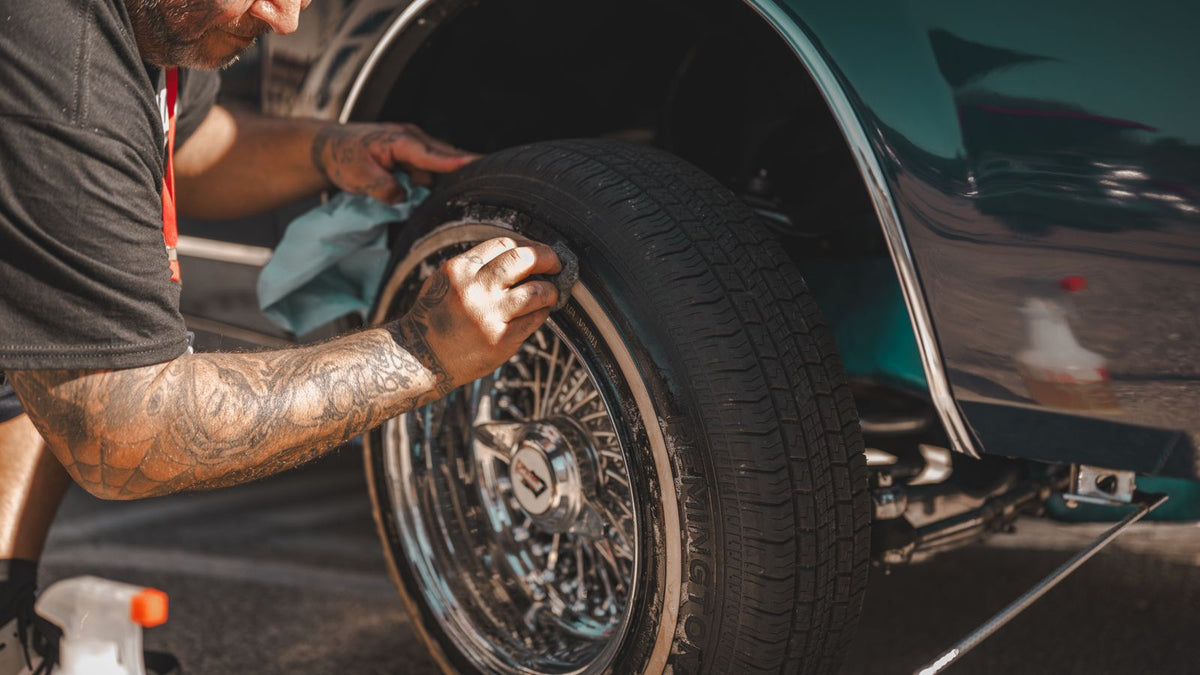
To polish aluminum, degrease it, sand out the scratches in steps (36 to 80 grit for deep damage, then 80 to 120, then 150 and finer), and buff. Cut with tripoli compound on a sewn cotton buff, then finish with white rouge on a loose cotton buff. Step up only once the previous scratches are gone, keep the part cool, and never run a wheel past the speed marked on it.
| Stage | Goal | Abrasive or compound | Typical tool | Finish family (Aluminum Association code) |
|---|---|---|---|---|
| 1. Clean | Remove oil, grease and loose dirt | Solvent or alkaline degreaser | Rag, wash tank | C11, degreased |
| 2. Rough polish | Remove pits, deep scratches, casting and mill marks | 36 to 80 grit, used dry | Flap disc, sanding belt, set-up polishing wheel | M10, as fabricated (starting point) |
| 3. Intermediate polish | Remove the stage 2 scratch pattern | 80 to 120 grit, used dry | Flap disc, belt, non-woven wheel | M3x, directional textured (satin) |
| 4. Fine polish | Refine the scratches until they are uniform and shallow | 150 grit and finer, wheel oiled or greased | Belt, fine non-woven wheel | M3x satin, or preparation for buffing |
| 5. Cut buff | Remove the last grit lines and raise a lustre | Tripoli compound | Sewn cotton buff | M2x, buffed |
| 6. Colour buff | Bring up the final mirror-bright shine | White rouge or white colouring compound | Loose 100% cotton buff | M21 smooth specular / M22 specular |
| 7. Clean off | Remove compound residue | Degreaser, clean soft cloth | Rag | Final surface |
Grit ranges, compounds and buff types: Products Finishing, "Some Buffing and Polishing Basics". Finish codes: Aluminum Association designation system as published by the Aluminum Anodizers Council. The grit ranges are general polishing practice; begin at the finest stage that still removes the worst defect on your part.
How to use the sequence
Start by judging the worst mark on the part. A deep gouge, a casting parting line or a weld needs stage 2. A part that only shows light oxidation and fine scratches can often start at stage 4. Starting coarser than the damage requires only adds scratches you then have to remove.
Each stage has one job: remove the scratch pattern left by the stage before it. Change the sanding direction between grits so the old scratches show up across the new ones, and move on only when the old pattern has disappeared. Our grit progression guide explains why skipping more than one step costs time.
Stop at stage 3 or 4 if you want a brushed or satin look. The Aluminum Association groups these grained finishes as M3x, directional textured, from M31 fine satin to M33 coarse satin, plus M34 hand rubbed and M35 brushed. Go on to stages 5 and 6 for a mirror. The buffed group is M2x: M21 smooth specular and M22 specular. Specifiers write these codes on drawings, and a finisher can quote against them.
At the buff, load the compound lightly and often. Touch the bar to the spinning buff for a second or two, work the part, and reload when the cut slows. Too much compound smears and leaves a greasy haze that the colour stage then has to clear.
Buffing wheel speed for aluminum
Surface speed (sfm) = pi x wheel diameter in inches x rpm / 12. Products Finishing gives 5,000 to 8,000 sfm as a general buffing range, and it shortens the constant to 1/4 (0.25 x diameter x rpm), which reads slightly low.
- A 6 in buff on a 3,450 rpm spindle: 3.1416 x 6 x 3,450 / 12 = about 5,419 sfm.
- An 8 in buff on the same spindle: 3.1416 x 8 x 3,450 / 12 = about 7,226 sfm.
Published aluminum-specific speeds disagree with each other, so treat the general range as an upper guide. Aluminum is soft and conducts heat quickly, so lower the speed or the pressure if the part becomes too hot to hold, the compound smears, or the surface goes dull and streaky. Whatever surface speed you aim for, the spindle rpm must stay at or below the maximum speed marked on the wheel or buff.
Common mistakes when polishing aluminum
- Sharing wheels with steel. CCOHS advises against grinding non-iron metals on ordinary wheels. Steel particles carried in a used wheel or buff scratch aluminum and can leave stains. Label a set of wheels, buffs and compound bars for aluminum only.
- Loading. Soft aluminum clogs fine abrasives quickly. Light pressure, open-coat products and a lubricant at the fine stages help; see how to grind aluminum without loading for the full set of causes and fixes.
- Jumping straight to compound. Tripoli removes fine scratches and grit lines. Pits and gouges that were not sanded out at stages 2 to 4 stay visible under a mirror finish, often more clearly than before.
- Polishing over a coating. Clear coat, paint and anodizing sit on top of the metal. The sequence above works on bare aluminum; remove the coating first or the compound simply works the coating.
- Mixing compounds on one buff. Use one buff per compound. Coarse tripoli residue in the colour buff will put scratches back into the finish.
Safety at the buffing wheel
CCOHS's checklist for bench and pedestal grinders covers the same machines that drive most buffing wheels. Confirm the spindle speed does not exceed the speed marked on the wheel, keep guards in place, stand to one side while the wheel comes up to speed, and wear eye, ear and face protection. Keep tool rests within 3 mm (1/8 in.) on grinding wheels, avoid loose clothing and long loose hair, and wear gloves only where there is no risk of entanglement.
A buff can grab an edge and throw the part. Hold the work firmly, present edges so they trail away from the direction of rotation, and never hold small pieces by hand. Use a clamp or holder for those.
Aluminum dust needs housekeeping. OSHA lists aluminum among the metals that can form combustible dust, so collect it, keep it from building up on ledges and in ducts, and keep the aluminum polishing area apart from steel grinding sparks.
Wheels and discs for each stage
For stages 2 and 3, aluminum oxide and zirconia flap discs on an angle grinder handle weld and casting cleanup on flat and curved parts. For stage 4 and satin finishes, our non-woven polishing wheels include nylon fibre flap discs and wheels in 240 grit. For stages 5 and 6, the polishing wheels collection has compressed wool felt buffing wheels for bench machines from 3 to 8 in diameter, with the arbor size listed on each product and ready to load with compound, plus wool felt flap discs for angle grinders.
Shops running polishing in volume can ask for bulk pricing or samples on our quote page, or send a drawing with the finish code and we will help match the wheels to each stage.
Related reading
- How to Grind Aluminum Without Loading: Stop Clogging & Cross-Contamination
- Grit Progression & Sequencing: Never Skip More Than One Step
- How to Achieve a #4 Brushed or #8 Mirror Finish on Stainless Steel
Frequently asked questions
What compound do you use to polish aluminum?
Tripoli is the usual cutting compound for aluminum and other nonferrous metals. White rouge, or a white colouring compound, is the usual final step for a bright finish. Products Finishing lists both for aluminum and nonferrous work.
How fast should a buffing wheel turn for aluminum?
Products Finishing gives 5,000 to 8,000 sfm as a general buffing range. Sources disagree on an aluminum-specific figure, so run toward the lower end if the part gets hot or the compound smears. Surface speed is pi x wheel diameter in inches x rpm / 12, and the spindle must never exceed the speed marked on the wheel.
Can I use the same buffs and discs on steel and aluminum?
Keep separate wheels, buffs and compounds for aluminum. CCOHS warns against grinding non-iron metals on ordinary wheels, and steel particles carried over from a used buff can scratch and stain the softer aluminum surface.
Can you polish aluminum wheels or rims?
Yes, on bare metal. Many factory rims carry paint or a clear coat, and that coating has to come off before compound will touch the aluminum. After that the same ladder applies: sand out the damage, step up in grit, cut with tripoli, then colour with white rouge.
How do you polish aluminum?
Degrease the part, then sand out the damage in stages: 36 to 80 grit for pits and deep scratches, 80 to 120 to remove that pattern, then 150 and finer until the scratches are shallow and even. Cut with tripoli compound on a sewn cotton buff, bring up the shine with white rouge on a loose cotton buff, and wipe off the residue. Move on only once the previous scratches are gone, and keep the part cool.
How do you buff aluminum?
Buff only after the part is sanded to 150 grit or finer. Touch the compound bar to the spinning buff for a second or two, work the part, and reload when the cut slows. Use tripoli on a sewn cotton buff first, then white rouge on a loose cotton buff, keeping one buff per compound. Hold the work firmly and never run the buff above the maximum RPM marked on it. See our buffing and polishing wheels.
How do you shine up aluminum that is already polished?
Start at the finest stage that removes the worst mark. A polished part with only light oxidation and fine scratches can often skip the coarse grits. Refine with 150 grit or finer if needed, then cut with tripoli and colour with white rouge. If a pit or gouge still shows, go back a sanding stage, since compound only removes fine scratches and grit lines.