
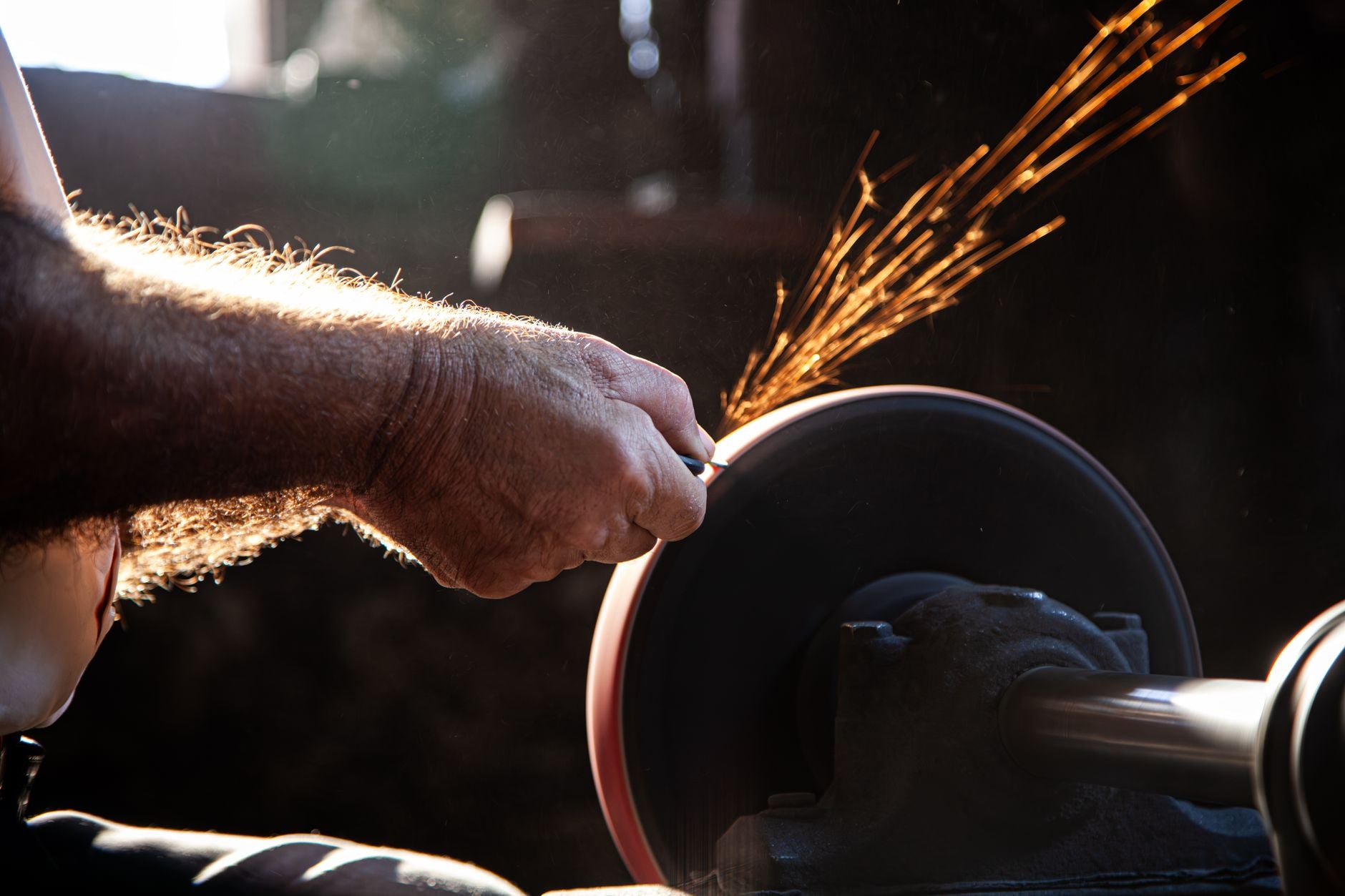
Quick Answer
To dress a bench grinder wheel: put on eye, face and dust protection, check the guard and tool rest, bring the grinder to full speed, then rest the dresser on the tool rest and traverse it lightly and evenly across the wheel face until the face is clean, flat and uniformly dull again. A star dresser is the fast cleanup tool for a glazed or loaded vitrified wheel, a single-point diamond leaves the flattest, squarest face for sharpening work, and a silicon-carbide dressing stick is the light-touch option and the only correct dresser for diamond and CBN wheels. The whole job takes about five minutes, and you must re-set the tool-rest gap afterwards because dressing shrinks the wheel (CRATEX; KB: Wheel Dressing and Truing).
First, diagnose: glazed or loaded?
A wheel that has stopped cutting is almost always one of two things, and from three feet away they look the same: a smooth, shiny face that rubs instead of bites. Up close they are opposites, and misreading one for the other leads to the wrong fix (KB: Loading and Glazing).
Glazed means the abrasive grains have worn flat and polished over instead of fracturing to expose fresh edges. The face looks glassy, the spark stream falls off, and the workpiece heats up fast while almost no metal comes off. Glazing shows up on hard steel when the wheel grade is too hard for the job, or when very light pressure polishes the grain tips instead of working them hard enough to fracture (KB: Loading and Glazing; Self-Sharpening Mechanism).
Loaded means the grains are still sharp but buried. Soft, gummy material such as aluminum, brass, copper or paint smears into the pores between grains and welds there, leaving a visible metallic film or streaks on the face. Fine-grit wheels load fastest because there is less chip room between grains (KB: Loading and Glazing; Loading).
| Sign | Glazed wheel | Loaded wheel |
|---|---|---|
| Face appearance | Shiny, glassy, smooth | Smeared metallic film packed into the pores |
| Grain condition | Dull, worn flat | Still sharp, but buried under debris |
| Typical work | Hard steel, hardened tools | Aluminum, brass, copper, paint |
| Grit effect | Driven by grade and grain, not grit | Worse with fine grit (less chip room) |
| Heat signature | Heat with almost no stock removal | Friction heat as the face clogs |
| Dressing fix | Dress to fracture out dulled grain; if it keeps recurring, go one grade softer | Dress to strip the packed layer; if it keeps recurring, go coarser |
Left alone, both end the same way: the wheel pumps heat into the part instead of removing metal, and edges turn blue. If your parts are burning, see our guide on how to prevent grinding burn.
Star vs diamond vs dressing stick
All three dressers restore the face; they differ in how aggressively they do it and what face they leave behind (KB: Wheel Dressing and Truing; Bench and Pedestal Grinder).
| Dresser | What it is | Best for | Face it leaves |
|---|---|---|---|
| Star (Huntington) dresser | Hardened, serrated star-shaped cutters spinning free in a handle | Fast cleanup of a glazed or heavily loaded vitrified bench wheel | Open, coarse, free-cutting; not a precision face |
| Single-point diamond | One diamond mounted in a tool or handle | Truing the wheel flat and square for sharpening work | The most precise, squarest face |
| Dressing stick | Bonded silicon-carbide or aluminum-oxide stick | Light glaze, small wheels, touch-ups; the only correct dresser for diamond and CBN wheels | Light, fine conditioning |
Two technique details worth knowing for the diamond: hold it angled roughly 10 to 15 degrees into the direction of wheel rotation, and rotate it in its holder 20 to 40 degrees from time to time so the diamond wears a point rather than a flat (CRATEX; KB: Wheel Dressing and Truing). For dressing sticks, pick a stick one to two grit steps finer than the wheel you are dressing (Eagle Superabrasives; KB: Wheel Dressing and Truing).
One hard rule: never use a single-point or multi-point diamond dresser on a diamond or CBN wheel. It will cause serious, irreparable damage to the superabrasive layer. Those wheels get a silicon-carbide or aluminum-oxide stick instead (Eagle Superabrasives; KB: Wheel Dressing and Truing).
How to dress a bench grinder wheel, step by step
- Kit up. Safety glasses under a face shield plus dust protection; dressing throws a burst of abrasive and metal dust. No loose sleeves, no gloves near the wheel, tie back long hair (CRATEX; KB: Wheel Dressing and Truing).
- Check the machine. Guard on, wheel visually sound, tool rest tight. If you are mounting a fresh wheel first, ring-test it and follow the mounting rules in our grinding wheel safety guide (OSHA 1910.215(d); KB: Wheel Ring Test And Mounting Safety).
- Set the rest. The dresser works off the tool rest, so it must be close to the wheel and locked down before you start.
- Run up to speed. Start the grinder, stand to the side of the wheel plane, and let it reach full speed.
- Make contact lightly. Rest the dresser flat on the tool rest and bring it against the face with light, even pressure.
- Traverse. Move the dresser steadily side to side across the full width of the face in light passes. Stop when the face is uniformly clean and flat and the machine runs without felt vibration.
- Re-set the gaps. Switch off, let the wheel stop, then re-adjust the tool rest and the tongue guard. Dressing removed diameter, so both gaps just opened up (OSHA 1910.215; KB: Bench and Pedestal Grinder).
Budget about five minutes for the whole pass (CRATEX; KB: Wheel Dressing and Truing).
The tool-rest gap rule
The gap between the tool rest and the wheel is the most-checked number on a bench grinder. Under OSHA 1910.215(a)(4) the work rest must be kept adjusted to within 1/8 inch (3 mm) of the wheel, and the tongue guard at the top of the guard to within 1/4 inch of the periphery; Ontario's O. Reg. 851 carries the same 3 mm work-rest clearance (OSHA 1910.215; KB: OSHA Abrasive Wheel Machinery 1910.215). Bench-dressing guidance is tighter still: keep the rest within 1/16 inch of the wheel before and after dressing (CRATEX; KB: Wheel Dressing and Truing). Read 1/8 inch as the legal ceiling and 1/16 inch as good shop practice.
The reason is not cosmetic. A wider gap can let the workpiece get dragged and jammed between the rest and the spinning wheel, which can shatter the wheel (KB: Wheel Ring Test And Mounting Safety). And because both gaps open up as the wheel wears, a grinder that was compliant in the morning can be out of spec by the afternoon; these two clearances are among the most-cited defects OSHA inspectors find on grinders (KB: OSHA Abrasive Wheel Machinery 1910.215). Re-check them every time you dress, with the machine off.
Coarse dress = softer-acting wheel
Dressing is not just maintenance, it is a tuning knob. A coarse, fast, aggressive dress leaves an open face with sharp grain standing proud: the wheel acts softer, cuts freer and runs cooler. A fine, slow, gentle dress closes the face up: the wheel acts harder and leaves a finer finish. Same wheel, same spec code, different behaviour (KB: Wheel Dressing and Truing).
There is a cost side too. A dressing pass spends wheel: roughly 0.2 mm of thickness can go per dress, so a wheel that glazes every half hour and gets dressed every half hour can lose more material to the dresser than to actual grinding. If you are dressing constantly, the wheel is wrong for the job. Chronic glazing means the grade is too hard; dropping one grade letter softer is the standard first fix (KB: Loading and Glazing; Wheel Hardness Grade Scale). Our bench grinding wheel selection guide covers how grit, grade and grain map to the job, and the Type 1 vitrified bench wheels we stock cover the common toolroom sizes.
Grain choice feeds the same loop. The grey aluminum-oxide wheels fitted to most grinders are tough and tend to glaze and blunt on hard tool steel; friable white aluminum oxide keeps fracturing to expose fresh edges, so it cuts cooler on HSS, at the price of wearing faster and needing more frequent dressing (KB: Bench and Pedestal Grinder).
What you never need to dress
Dressing is a vitrified bench and pedestal wheel routine. The portable bonded products in our grinding and cutting ranges effectively never see a dresser: thin cut-off wheels are consumed before they could be dressed, depressed-centre grinding wheels self-sharpen by design, and flap discs shed worn flaps to expose fresh abrasive, which is a built-in self-dressing effect (KB: Wheel Dressing and Truing). If a flap disc or sanding disc has stopped cutting, that is usually loading, and the playbook is different; see our guide on flap disc maintenance and deglazing.
FAQ
How do I know if my grinding wheel is glazed or loaded?
Look at the face up close. Glazed: glassy and shiny, dull grains, heat with almost no metal removal, typically on hard steel. Loaded: a smeared metallic film of aluminum, brass or paint packed into the pores, with the grain still sharp underneath. Both dress out, but the recurring causes differ.
Which dresser is best for a bench grinder wheel?
A star (Huntington) dresser for fast cleanup of a glazed or loaded face, a single-point diamond when you want the flattest, squarest face for sharpening work, and a silicon-carbide dressing stick for light touch-ups and small wheels.
How far should the tool rest be from the grinding wheel?
Within 1/8 inch (3 mm) as the legal maximum under OSHA 1910.215(a)(4), with 1/16 inch as tighter shop practice; the tongue guard sits within 1/4 inch. Re-set both every time you dress, because dressing shrinks the wheel diameter.
How often should you dress a bench grinder wheel?
There is no calendar interval. Dress on signals: a shiny or smeared face, felt vibration, grooves, burning work, or loss of cut. A typical dressing pass takes about five minutes. If you are dressing every half hour, the wheel grade is too hard for the job; go softer instead.
Can I use a diamond dresser on a diamond or CBN wheel?
No. Diamond dressers are for conventional aluminum-oxide and silicon-carbide wheels only; on a diamond or CBN wheel they cause serious, irreparable damage. Use a silicon-carbide or aluminum-oxide dressing stick, picked one to two grit steps finer than the wheel.
Does dressing make a wheel cut faster?
Yes. A coarse, aggressive dress leaves an open face with sharp grain exposed, so the wheel acts softer and cuts freer and cooler; a fine, slow dress closes the face for a harder action and a finer finish. Dressing effectively re-tunes the wheel without changing its spec.