
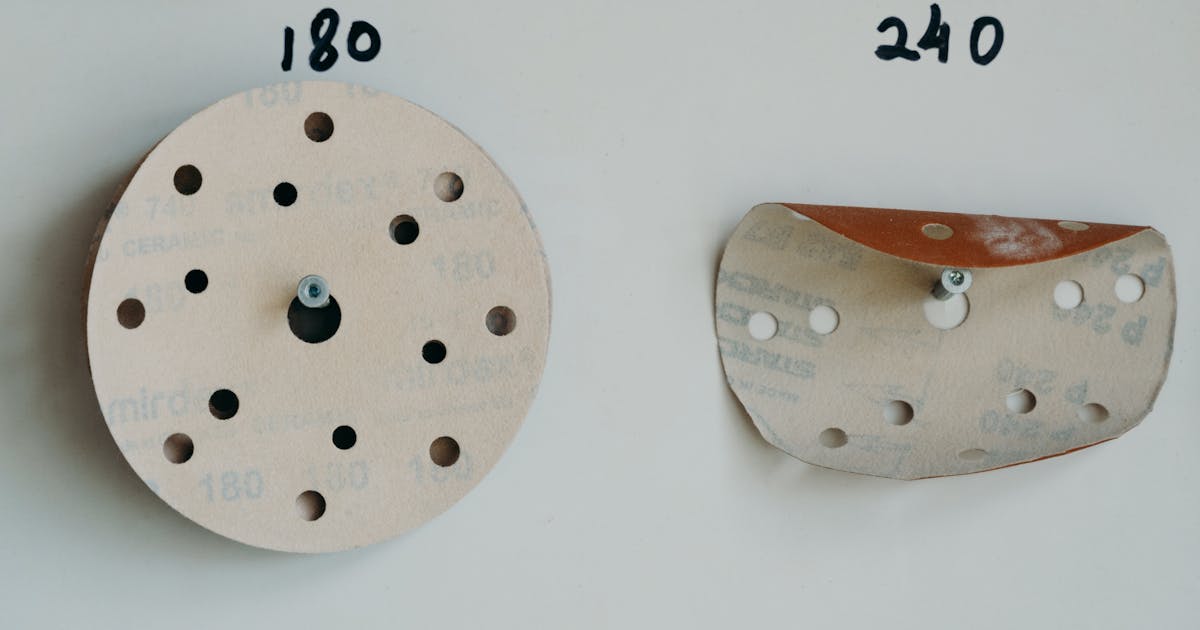
What Grit Number Actually Means
The grit number on an abrasive product specifies the particle size of the abrasive grain, referenced against a standardized sieve. In the FEPA (Federation of European Producers of Abrasives) system — used across Canada, Europe, and most of the industrial world — lower numbers indicate larger, coarser particles; higher numbers indicate finer particles that produce smoother surface finishes.
A P24 disc contains particles approximately 764 microns in diameter. A P120 disc contains particles approximately 125 microns in diameter. The relationship is inverse and non-linear, which is why grit progressions should never skip more than one or two grades in a finishing sequence.
The FEPA Grit Scale: An Industrial Reference
| Grit Range | Classification | Approx. Particle Size | Primary Use |
|---|---|---|---|
| P16 – P36 | Very Coarse | 500 – 1,000+ μm | Aggressive stock removal, weld seam grinding, casting cleanup |
| P40 – P60 | Coarse | 265 – 425 μm | General stock removal, deburring, weld blending on structural steel |
| P80 – P120 | Medium | 115 – 190 μm | Intermediate grinding, blending scratches from coarser passes, surface prep for coating |
| P150 – P240 | Fine | 50 – 100 μm | Pre-finish blending, scratch refinement, paint/coating preparation |
| P280 – P400 | Very Fine | 35 – 58 μm | Final finishing, polishing prep, stainless scratch pattern control |
| P600+ | Ultra Fine | <26 μm | High-gloss finishing, micro-finishing, precision surface preparation |
Grit by Application: What Industrial Buyers Need to Know
Weld Removal and Heavy Stock Grinding
Start with P24–P40 for initial weld cap removal or casting flash cleanup. These grits remove material fast but leave deep scratches that require subsequent passes to address. Pair with ZA or CE grain for maximum cut rate and wheel longevity. Do not attempt to use coarse grits on thin-gauge material — the risk of burning through or distorting the workpiece is significant.
General Fabrication Grinding
P40–P80 covers the widest range of general fabrication tasks: deburring sheared edges, blending weld toes, and surface preparation before primer or powder coat. P60 is often the single most versatile grit for a mixed fabrication shop. Standard aluminum oxide (A) grain at this grit level provides acceptable performance across mild steel, structural steel, and aluminium.
Surface Preparation for Coating
Most industrial coating specifications — including SSPC SP-3, SP-6, and SP-11 — reference an anchor profile depth that corresponds to a specific grit range. P40–P80 typically generates the 40–75 micron anchor profile required for epoxy and polyurethane topcoats. Verify the coating manufacturer's surface profile requirement before specifying an abrasive for prep work, as over-grinding (too coarse) can be as problematic as under-grinding.
Stainless Steel Finishing
Stainless applications almost always require a defined scratch pattern for both aesthetic and functional reasons. The standard No. 4 architectural finish is achieved with a P120–P180 progression. A No. 3 finish (coarser, directional) typically uses P80–P100. For food-grade or pharmaceutical equipment where surface Ra is specified, a full progression from P80 through P240 or finer is standard practice. Always use ceramic (CE) grain on stainless to minimize heat input and prevent sensitization.
Aluminium and Non-Ferrous Metals
Non-ferrous metals load abrasives quickly — the soft material fills the spaces between grains, causing glazing and burning. Use P60–P120 silicon carbide (C) grain with an open-coat structure, and consider products with stearate loading (anti-loading treatment) for longer effective life. Avoid pushing too hard; light pressure with frequent repositioning extends consumable life significantly on aluminium.
Sanding Belts and Wide-Belt Applications
Belt sanding follows the same FEPA scale, but the contact area and machine feed rate change the effective cut aggressiveness significantly. A P80 belt on a wide-belt sander with a steel platen generates considerably more material removal than a P80 flap disc by hand. When specifying belts for automated equipment, always verify the grit recommendation against the machine manufacturer's guidelines and expected surface finish output.
Building a Grit Progression
A grit progression is the sequence of increasing grit numbers used to bring a surface from raw to finished in multiple passes. The cardinal rule: each pass must remove the scratches left by the previous grit before advancing to a finer grade. Skipping grits does not save time — it means spending far longer at the finer grit trying to remove marks it was not designed to address efficiently.
A typical progression for weld finishing on mild steel might be:
- P36 or P40 — weld cap removal and gross levelling
- P60 or P80 — blend scratch pattern from P36/P40 passes
- P120 — refine surface, remove P60/P80 scratches
- P180 or P240 — final scratch pattern for paint adhesion or inspection
For stainless with a No. 4 finish specification, the progression typically extends to P150–P180 minimum, often with a final pass using a Scotch-Brite™-type non-woven product to produce a consistent directional grain.
Key Procurement Considerations
When managing abrasive SKU counts across a facility, resist the temptation to standardize on a single grit. A P60 disc used for fine finishing work represents wasted consumable life and increased process time. Conversely, a P120 disc used for gross weld removal will dull rapidly and fail prematurely. Matching grit to task is one of the highest-ROI decisions in consumable procurement.
For high-volume operations, consider running a controlled trial across two or three grit options per application and measuring actual parts-per-disc and cycle time. The data will almost always justify the small investment in trial stock.
Next in This Series
Grit determines how fine your cut is. Bond type and backing material determine how the abrasive holds together under load, heat, and pressure. Our next post covers resin bonds, backing weights, and how to match them to your equipment and application.
Shop Whitby Abrasives
Industrial-grade abrasives for Canadian fabricators — available for online order and local pickup in Whitby, Ontario.
Product Catalogues: Cutting Wheels • Grinding Wheels • Flap Discs • Sanding Belts • Sanding Discs • Strip Discs • Polishing Wheels • Rubber Deburring Wheels • Nylon Fibre Deburring Wheels • Mounted Flap Wheels • Vitrified Bench Grinding Wheels • Accessories
📧 info@whitbyabrasives.com • 📍 1450 Victoria Street East, Unit 2, Whitby, ON L1N 0N7 • About Us • Contact Us