
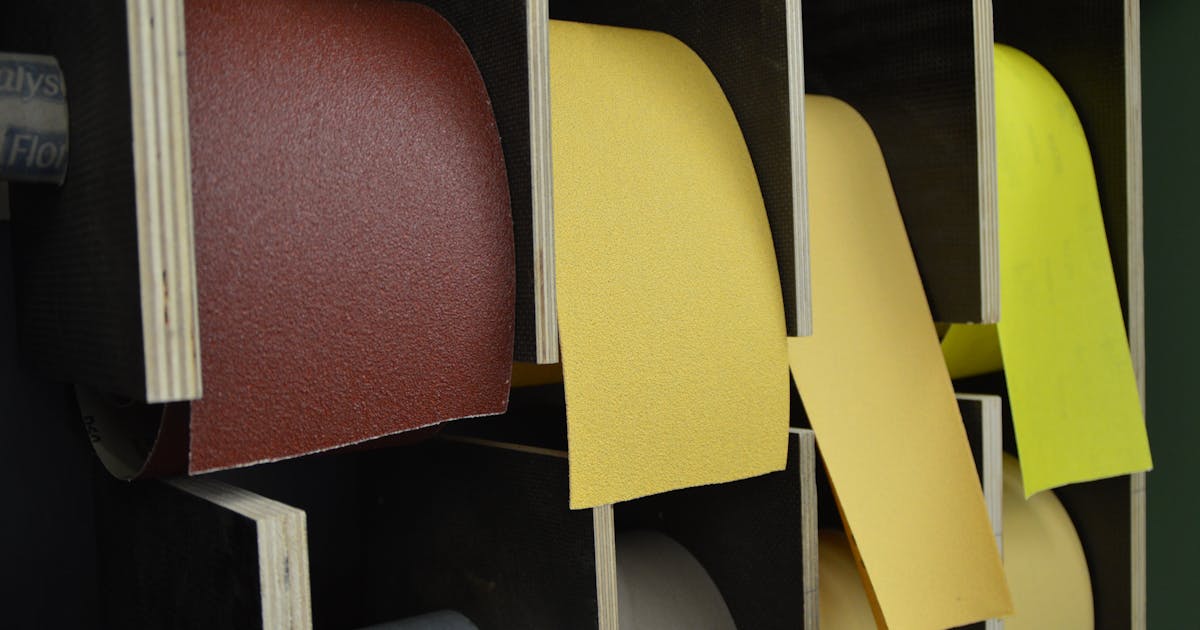
The Role of Bond and Backing in Abrasive Performance
An abrasive product is a composite system: grain, bond, and backing each contribute to the final performance profile. The grain determines what you can cut and to what finish. The bond controls how firmly the grain is held and how it releases when dulled. The backing controls flexibility, tensile strength, heat resistance, and compatibility with wet or dry use. Mismatching any element of this system to the application produces avoidable consumable failures.
Bond Systems
Resin Over Resin (ROR) Bond
The dominant bond system for bonded abrasive products — grinding wheels, cut-off wheels, and depressed-centre grinding discs — is resin over resin (ROR). A phenolic resin base coat anchors the grain to the backing; a second resin size coat encapsulates the grain, locking it in place and protecting it during operation.
- Advantages: High tensile strength, excellent heat resistance up to ~200°C at the bond line, resistant to side loading
- Grain release mechanism: The bond holds grain until it dulls, then releases it to expose fresh grain below (this is called "friability" of the bond system, distinct from grain friability)
- Harder bonds hold grain longer and are suited to softer materials where the workpiece generates less abrasive stress
- Softer bonds release grain more readily and are suited to harder materials — the grain is ejected before it glazes, keeping the surface sharp
Bond hardness in bonded abrasives is specified by a letter grade (typically A through Z, where A is softest). Matching bond hardness to workpiece hardness is the most commonly overlooked variable in grinding wheel selection.
Resin Bond for Coated Abrasives
Coated abrasives (discs, belts, sheets) use a two-layer resin system as well, but at much lower coat weights than bonded abrasives. The make coat adheres the grain to the backing; the size coat anchors the grain and controls the spacing and flexibility of the abrasive layer. Some products include a supersize coat that adds functional treatments such as stearate anti-loading agents or grinding aids.
Vitrified Bond
Vitrified bonds — glass-ceramic systems fired at high temperatures — are used almost exclusively in precision grinding wheels (cylindrical, surface, and tool grinding). They are not typically found in angle grinder or handheld applications. If your procurement covers precision grinding equipment, vitrified wheels offer superior form retention and are dressable, but they are brittle and sensitive to impact and temperature shock.
Backing Materials for Coated Abrasives
Vulcanized Fibre (Fibre Discs)
Vulcanized fibre is produced by treating cellulose sheets with zinc chloride, creating a dense, rigid-yet-flexible material. It is the standard backing for Type 27 fibre discs used on angle grinders with a backing pad.
- Thickness: Typically 0.8 mm
- Advantages: Low cost, good stiffness for aggressive stock removal, compatible with standard rubber or plastic backing pads
- Limitations: Sensitive to moisture — fibre discs must be stored in dry conditions and should not be used wet. Moisture causes the fibre to swell and delaminate, significantly reducing burst strength. Discard any disc that has been exposed to prolonged humidity.
- Typical grit range: P24–P120
Cloth Backing (Woven Cotton or Polyester)
Cloth backings provide significantly higher tensile strength than paper and good resistance to tearing under lateral load. They are the standard backing for abrasive belts, flap disc lamellae, and heavy-duty hand pads.
Cloth weight is designated by a letter system:
- J-weight (Jeans): Lightweight, flexible — suited for contour sanding, curved surfaces, and applications where the abrasive needs to conform to the workpiece
- X-weight (Drills): Medium-weight, semi-rigid — the most common belt and disc backing; balances flexibility with durability for general fabrication
- Y-weight: Heavy-duty, stiff — used for high-pressure belt grinding on structural steel, wide-belt machines, and applications requiring maximum backing integrity
- ZX / XY blends: Layered constructions combining two weights for intermediate stiffness profiles
For flap discs, the backing cloth weight directly affects how the disc wears: J-weight cloth flaps cut more aggressively on contours; X-weight flaps last longer on flat surfaces under consistent pressure.
Paper Backing
Paper backings are categorized by weight:
- A-weight (lightest): Highly flexible, used for hand sanding and finish work
- C and D-weight: Stiffer, used for orbital sander sheets and disc pads
- E-weight (heaviest): Near-cloth stiffness, used for machine sanding of flat stock
Paper-backed abrasives are not suited to wet applications unless specifically designated as waterproof (typically using a latex-treated or resin-bonded paper). Waterproof paper-backed products ("wet-or-dry" sheets) use silicon carbide grain and are standard in automotive finishing workflows.
Non-Woven / Nylon Web (Surface Conditioning Type)
Non-woven abrasive products use a three-dimensional nylon fibre web as the carrier. Abrasive grain is distributed throughout the web matrix rather than coated on a surface. This construction provides:
- Consistent cutting action throughout the product's life (no substrate exposure as the product wears)
- Excellent conformability to complex geometries
- Lower cutting aggression — suited to cleaning, deburring, and finish blending rather than stock removal
Non-woven products are specified by grade (coarse, medium, fine, very fine, ultra fine) rather than FEPA grit number. They are commonly the final step in a stainless finishing progression, used to produce a consistent directional grain on No. 4 or No. 3 surfaces.
Fibre-Reinforced Resin (Cut-Off and Grinding Wheels)
Type 1 cut-off wheels and Type 27 grinding discs are not coated abrasives — they are bonded abrasive products reinforced with fibreglass mesh layers embedded in the resin matrix. The glass reinforcement provides the tensile strength that allows these products to operate safely at speeds exceeding 80 m/s (approximately 15,700 SFPM).
Reinforcement layers are typically:
- 1 layer: Standard cut-off wheels (Type 1 — flat profile)
- 2 layers: Depressed-centre grinding discs (Type 27) and heavy-duty cut-off wheels
The number of reinforcement layers directly affects the product's resistance to lateral load. Never apply side pressure to a Type 1 cut-off wheel — it is designed for cutting only, not grinding.
Matching Bond and Backing to Equipment
| Product Type | Bond System | Backing | Typical Application |
|---|---|---|---|
| Type 1 Cut-Off Wheel | Resin Over Resin | Fibreglass reinforced | Cutting: pipe, bar stock, structural profiles |
| Type 27 Grinding Disc | Resin Over Resin | Fibreglass reinforced | Stock removal, weld grinding, surface grinding |
| Fibre Disc | ROR (coated) | Vulcanized fibre | Aggressive grinding with backing pad |
| Flap Disc | ROR (coated cloth) | X or J-weight cloth lamellae | Blending, finishing, contour work |
| Abrasive Belt | ROR (coated) | X or Y-weight cloth | Belt grinding, wide-belt sanding, finishing |
| PSA/Hook Disc | ROR (coated) | C/D-weight paper or cloth | Random orbital sanding, auto-body, finishing |
| Non-Woven Disc/Belt | Web-distributed | Nylon fibre web | Blending, finishing, cleaning, deburring |
Storage and Handling Implications
Bond and backing type directly determine storage requirements. Resin-bonded products should be stored at 15–25°C and 45–65% relative humidity — excessive heat accelerates resin degradation; excess moisture affects fibre backings. Rotate inventory on a FIFO basis and inspect all products visually before use. Products showing delamination, cracks, or moisture damage should never be placed in service.
Next in This Series
With grain, grit, bond, and backing covered, our next post takes a practical view: how to match the right abrasive product type — cut-off wheel, grinding disc, flap disc, or sanding belt — to specific industrial operations.
Shop Whitby Abrasives
Industrial-grade abrasives for Canadian fabricators — available for online order and local pickup in Whitby, Ontario.
Product Catalogues: Cutting Wheels • Grinding Wheels • Flap Discs • Sanding Belts • Sanding Discs • Strip Discs • Polishing Wheels • Rubber Deburring Wheels • Nylon Fibre Deburring Wheels • Mounted Flap Wheels • Vitrified Bench Grinding Wheels • Accessories
📧 info@whitbyabrasives.com • 📍 1450 Victoria Street East, Unit 2, Whitby, ON L1N 0N7 • About Us • Contact Us