
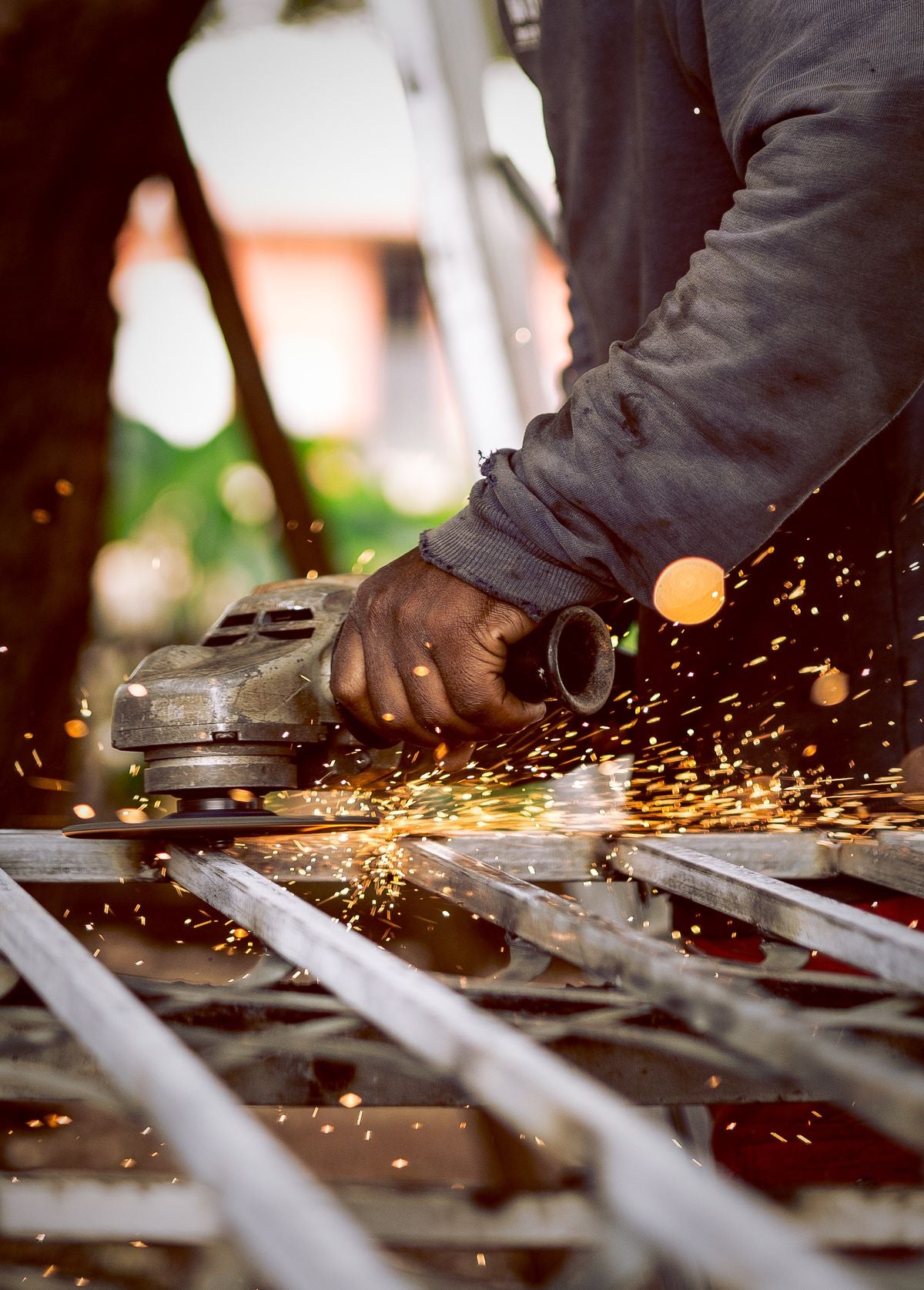
Quick answer: Abrasive safety in Ontario means controlling respirable crystalline silica dust, guarding and speed-rating wheels to ANSI B7.1 and O. Reg. 851, and supplying the right PPE. Under Ontario's Designated Substances Regulation (O. Reg. 490/09), the 8-hour exposure limit for quartz silica is 0.10 mg/m³ (0.05 mg/m³ for cristobalite), and employers must assess exposure, control it, and protect workers. Whitby Abrasives, a Canadian supplier based in Whitby, Ontario, helps shops cut that risk with low-dust, cooler-cutting abrasives and compliant product documentation.
Every grinding, cutting, and sanding operation throws off dust. When the workpiece is steel, stone, concrete, or engineered countertop material, that dust often contains respirable crystalline silica — particles fine enough to lodge deep in the lungs and cause silicosis, lung cancer, and kidney disease. For any Ontario fabrication shop, getting abrasive safety right is both a legal duty and a productivity issue: cleaner air, fewer rework cycles, and lower compliance risk all pull in the same direction. This guide walks through what the rules actually require, what they leave to professional judgment, and how product and grain choices reduce exposure at the source.
The Silica Hazard: Why Grinding Dust Is Regulated
Respirable crystalline silica is a confirmed carcinogen. The dust generated by dry grinding on concrete, masonry, stone, and engineered countertops is among the highest-risk tasks regulators flag, alongside abrasive blasting and cutting. The hazard is invisible — the particles that do the damage are too small to see — which is exactly why exposure is measured by air sampling rather than by eye.
Crucially, regulators have confirmed that grinding wheels and cutting discs are not exempt as inert "articles," because they release hazardous dust during normal use. That means the product itself carries hazard-communication obligations, and the shop using it carries exposure-control obligations. Both sides of that chain matter for a Durham Region or GTA fabricator.
Ontario OHSA and the Numbers That Apply
Workplace health and safety in Ontario runs under the Occupational Health and Safety Act (OHSA). Two regulations made under it govern most abrasive work:
- O. Reg. 490/09 (Designated Substances) — silica is a designated substance with a hard occupational exposure limit (OEL).
- O. Reg. 851 (Industrial Establishments) — covers grinding-wheel guarding, speed marking, and machine setup.
The Ontario exposure limits for respirable crystalline silica, measured as an 8-hour time-weighted average (TWA), are set in O. Reg. 490/09:
| Silica form | Ontario OEL (8-hr TWA) | Source |
|---|---|---|
| Quartz and Tripoli | 0.10 mg/m³ | O. Reg. 490/09 |
| Cristobalite | 0.05 mg/m³ | O. Reg. 490/09 |
Under O. Reg. 490/09, an Ontario employer must assess worker exposure to silica, implement a control program to comply with the OEL, provide respiratory protection along with wet methods or local exhaust ventilation, and supply hygiene facilities and worker training. On construction projects, a Section 30 obligation requires the project owner to determine whether silica is present and inform all bidding contractors — failing to do so creates liability for resulting damages. The Ontario Ministry of Labour also publishes a free Silica Control Tool for hazard assessments.
It is worth knowing how Ontario compares with other Canadian jurisdictions, because shops serving national customers or shipping work across provinces sometimes face stricter downstream limits:
| Jurisdiction | Quartz OEL (mg/m³, 8-hr TWA) | Notes |
|---|---|---|
| Ontario | 0.10 (quartz); 0.05 (cristobalite) | O. Reg. 490/09 |
| Quebec | 0.05 | Halved effective March 14, 2024 (Decree 280-2024) |
| British Columbia | 0.025 | Most stringent in Canada; ALARA substance |
| US (OSHA general industry) | 0.050 | PEL; action level 0.025 |
The direction of travel is clear: limits are tightening. Quebec halved its quartz limit to 0.05 mg/m³ in March 2024, aligning it with global best practice. An Ontario shop building to the strictest realistic standard today is future-proofing against the next regulatory revision rather than scrambling to catch up.
Grinding Dust Control: The Hierarchy That Works
Exposure-control regulations follow a hierarchy of controls — eliminate or reduce the hazard at the source first, then engineer it out, and only then rely on PPE. For abrasive work, effective grinding dust control means applying these in order:
- Engineering controls first. Local exhaust ventilation (LEV) captured at the tool, on-tool dust shrouds connected to a HEPA-rated extractor, and wet methods that suppress dust at the point of cut are the primary defence. Regulators require these before respirators in most cases.
- No dry sweeping. Dry sweeping and dry brushing of settled silica dust re-suspend it into the air; HEPA vacuuming or wet cleanup is the compliant alternative.
- Regulated areas and housekeeping. Containing dust-generating work and cleaning continuously keeps background exposure down for everyone in the shop, not just the operator.
- Respiratory protection last. Respirators fill the gap that engineering controls cannot close — they are a supplement, not a substitute.
Engineering controls do double duty. The same extraction that protects lungs keeps abrasive swarf off the workpiece and off finished surfaces, which is one less source of contamination-driven rework. For a shop already fighting rising operating costs — energy and skilled labour among them — reducing rework is a direct margin lever, not just a safety nicety.
PPE for Grinding: What Belongs on Every Operator
Proper PPE for grinding addresses three exposure paths at once — airborne dust, flying fragments, and noise. The product label on a compliant abrasive wheel carries pictograms indicating the protective equipment required for that product. At minimum, abrasive operations call for:
| Hazard | Protection | Why it matters |
|---|---|---|
| Respirable silica dust | Fit-tested respirator (matched to measured exposure) | Required where engineering controls cannot bring exposure below the OEL |
| Flying fragments / wheel breakage | Safety glasses plus face shield | A wheel that bursts releases high-energy fragments |
| Noise | Hearing protection | Grinding routinely exceeds safe sustained noise levels |
| Sparks / contact | Flame-resistant clothing, gloves | Hot swarf and incidental contact |
Respirator selection is not one-size-fits-all — it must match the exposure level the shop measures during its assessment. That is why the air-sampling step in O. Reg. 490/09 is not paperwork for its own sake: it determines which respirator class is actually adequate.
Wheel Safety: Speed, Guarding, and the Ring Test
Dust is not the only abrasive hazard regulated in Ontario. OHSA rules and the North American product benchmark, ANSI/UAMA B7.1-2017, govern the mechanical safety of the wheel itself. The non-negotiables:
- Maximum RPM marking. Under O. Reg. 851 the maximum operating speed must be legibly posted on the abrasive wheel and on the grinder. Never mount a wheel rated below the grinder's no-load RPM.
- Burst-speed safety factor. Quality bonded wheels are built and tested to withstand well above their marked speed — the EN 12413 benchmark requires a 1.73× burst-speed safety factor.
- Guarding. An ANSI B7.1-compliant guard is mandatory; bench grinders also require the work rest set within roughly 3 mm of the wheel.
- Ring (tap) test. Lightly tap a vitrified wheel before mounting — a clear ring means sound, a dull thud means damage. Discard a cracked wheel.
- Shelf life. Resin-bonded (B/BF) wheels degrade as their organic binders break down. EN 12413 sets a 3-year maximum shelf life for hand-held machine resin wheels; store stock dry, frost-free, and rotate oldest-first.
For a marking-by-marking breakdown of what a compliant label must show, see our guide on how to read an abrasive wheel label, and our companion piece on speed ratings, inspection, storage, and PPE requirements.
How Product and Grain Choices Reduce Risk
The most overlooked lever in abrasive safety is the abrasive itself. Two products that finish the same job can generate very different amounts of dust and heat — and that difference shows up directly in exposure readings and in operator fatigue.
- Cooler-cutting ceramic alumina. Ceramic alumina (sol-gel ceramic) grain is engineered to fracture and self-sharpen as it works, so it cuts faster at lower pressure and lower temperature. Less heat means less workpiece discolouration and less thermal stress — and a faster cut means fewer total seconds of dust generation per part.
- Low-dust formulations. Bonded and coated abrasives designed as low-dust abrasives reduce the volume of airborne particulate released per cut, lightening the load on your extraction system and helping keep readings under the OEL.
- Right product for the substrate. Matching wheel or disc to the material — rather than forcing a general-purpose product — cuts both cycle time and unnecessary dust.
The cost logic favours the better grain. A premium ceramic disc may carry a higher unit cost, but if it removes material faster and lasts longer, the cost per part — and the cumulative dust generated per part — can both fall. Pair that with proper extraction and PPE, and the shop gets a compounding benefit: lower exposure, fewer rework cycles, and a stronger compliance position. Explore options across our grinding wheel and flap disc catalogues.
Hazard Communication: The SDS Obligation
In Canada, abrasive products that release crystalline silica dust must carry a compliant Safety Data Sheet (SDS) under WHMIS 2015. The SDS follows the 16-section GHS format, must be provided in both English and French, and must identify the crystalline-silica hazards — cancer, silicosis, and immune and kidney effects. As a Canadian supplier, Whitby Abrasives treats SDS documentation and accurate wheel marking as part of the product, not an afterthought, so Ontario shops have the paperwork they need to satisfy their own WHMIS employer duties.
Frequently Asked Questions
What is the silica exposure limit for grinding in Ontario?
Under Ontario's Designated Substances Regulation (O. Reg. 490/09), the 8-hour time-weighted-average occupational exposure limit for respirable crystalline silica is 0.10 mg/m³ for quartz and tripoli, and 0.05 mg/m³ for cristobalite. Ontario employers must assess worker exposure, implement a control program to meet the limit, and provide respiratory protection and ventilation. Whitby Abrasives supplies low-dust abrasives that help Ontario shops stay below these limits.
Are grinding wheels exempt from hazard communication rules?
No. Regulators have confirmed that grinding wheels and cutting discs are not exempt as inert "articles," because they release hazardous dust during normal use. In Canada this means the product requires a WHMIS 2015 Safety Data Sheet in the 16-section GHS format, provided bilingually in English and French, identifying crystalline-silica hazards. The shop using the product also carries its own exposure-control and worker-training duties under Ontario's OHSA.
How do low-dust and ceramic abrasives improve safety?
Cooler-cutting ceramic alumina grain self-sharpens as it works, cutting faster at lower pressure and temperature, which shortens the time each part spends generating dust. Low-dust formulations release less airborne particulate per cut, easing the load on extraction systems. Together these product choices help keep exposure under the occupational limit while reducing heat damage and rework — a practical edge for fabricators across Whitby and the GTA.
What PPE is required for grinding in an Ontario shop?
Grinding requires layered protection: a fit-tested respirator matched to the measured silica exposure, safety glasses plus a face shield against flying fragments and wheel breakage, hearing protection, and flame-resistant clothing and gloves against sparks. Respirator class must match the exposure level the shop measures during its O. Reg. 490/09 assessment. The compliant abrasive's product label shows pictograms indicating the protective equipment required for that specific product.
What does ANSI B7.1 require for abrasive wheel safety?
ANSI/UAMA B7.1-2017, the North American benchmark, requires every wheel to be marked with its maximum operating speed, a compliant guard on the machine, a ring (tap) test on vitrified wheels before mounting, and a rule never to use a wheel rated below the grinder's no-load RPM. Ontario's O. Reg. 851 separately requires maximum RPM to be legibly posted on both the wheel and the grinder.
Shop Whitby Abrasives
Industrial-grade abrasives for Canadian fabricators — available for online order and local pickup in Whitby, Ontario.
Product Catalogues: Cutting Wheels • Grinding Wheels • Flap Discs • Sanding Belts • Sanding Discs • Strip Discs • Polishing Wheels • Rubber Deburring Wheels • Nylon Fibre Deburring Wheels • Mounted Flap Wheels • Vitrified Bench Grinding Wheels • Accessories
📧 info@whitbyabrasives.com • 📍 1450 Victoria Street East, Unit 2, Whitby, ON L1N 0N7 • About Us • Contact Us