
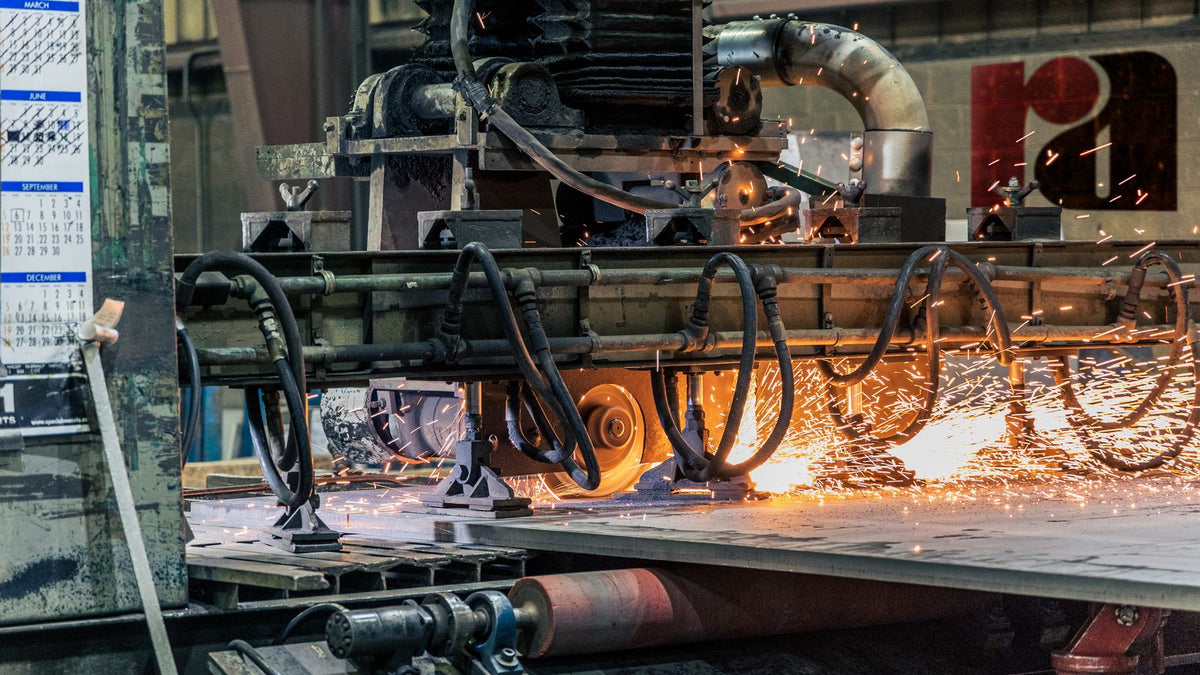
Canada's defence sector is in the middle of the biggest domestic manufacturing buildout in decades. Through 2026, Ottawa has committed billions of dollars to build new ammunition, armoured vehicle, and steel production capacity inside the country instead of buying it abroad. For Canadian metal fabrication shops, that shift means new work: cutting steel shell casings, welding and grinding vehicle hulls, and finishing a harder class of specialty steel than most shops handle day to day.
A $1.4 billion push into domestic ammunition production
In April 2026, the federal government confirmed $1.4 billion in funding to expand Canada's ammunition manufacturing base. General Dynamics Ordnance and Tactical Systems is putting over $1 billion into facilities in Quebec, including a nitrocellulose plant and a 155mm projectile assembly line in Le Gardeur. In Ingersoll, Ontario, IMT Precision is receiving up to $305 million to build metal shell production for 155mm artillery projectiles, Canada's first facility of its kind in years. Together, the projects are expected to support more than 350 construction and indirect jobs, and every one of those metal shells has to be cut, machined, and deburred before it leaves the plant.
Armoured vehicles and a steel supply chain built at home
In July 2026, Prime Minister Mark Carney announced a nearly $2 billion, four-year contract with General Dynamics Land Systems-Canada in London, Ontario, for 190 new armoured combat support vehicles, bringing the military's fleet to 550. The government says the deal will sustain more than 6,000 jobs a year across a supplier network that reaches Ryan Manufacturing in British Columbia, Interpro in Saskatchewan, Thales Canada in Quebec, and IMP Aerospace & Defence in Nova Scotia.
Separately, Canadian armoured vehicle maker Roshel has partnered with Swedish steelmaker Swebor to produce ballistic-protection steel domestically for the first time, licensing Swebor's technology instead of importing hardened plate from the United States, Europe, or Australia. Vehicle hulls built from that steel still need to be cut to size and have welds ground and blended, work that falls to fabrication shops rather than the steel mill itself.
A national strategy tying the projects together
These aren't isolated contracts. In February 2026, the federal government launched Canada's first Defence Industrial Strategy, targeting $180 billion in procurement opportunities and $290 billion in defence-related capital investment over the next decade, with a goal of 240% growth in Canadian defence industry revenue by 2035. The strategy specifically calls out the steel and aluminum sectors as candidates to pivot part of their production toward defence work, which points to more of this fabrication demand landing on existing Canadian metalworking shops rather than new dedicated defence plants alone.
What this means for WA customers
- Harder steel changes wheel and disc specs. Ballistic and defence-grade steel plate runs harder than mild structural steel. Shops picking up hull or shell-casing work should confirm their cutting-off wheels and grinding wheels are rated for the hardness and thickness involved, not just carried over from general fabrication stock.
- Deburring and finishing volume goes up alongside machining. Metal shell and vehicle component production adds a steady load of edge-breaking, weld blending, and surface finishing, which shows up as flap disc and non-woven consumable demand as much as cutting demand.
- The work is spreading regionally. Announced facilities and suppliers span Quebec, Ontario, British Columbia, Saskatchewan, and Nova Scotia, so shops outside the traditional defence hubs may see subcontract opportunities too.
If your shop is bidding on defence-adjacent fabrication work or just wants to make sure your current wheels and discs are specified correctly for harder steel, browse WA's full abrasives catalog to see what's in stock.
Frequently asked questions
Does this defence buildup change what abrasives a shop needs?
It can. Ballistic and defence-grade steel is harder and more abrasion resistant than typical mild steel, so shops taking on this work should confirm their cutting and grinding wheels are specified for high-hardness stock rather than general-purpose material.
Which parts of Canada are seeing this new fabrication work?
The announced projects are centred in Quebec and Ontario, with supplier contracts also reaching British Columbia, Saskatchewan, and Nova Scotia, so the added demand is not limited to one region.
Is this a short-term spike or a longer trend?
Government figures point to a longer runway. Canada's Defence Industrial Strategy lays out a 10-year procurement pipeline, and the ammunition and vehicle contracts announced so far run on multi-year construction and production timelines.