
Quick Answer
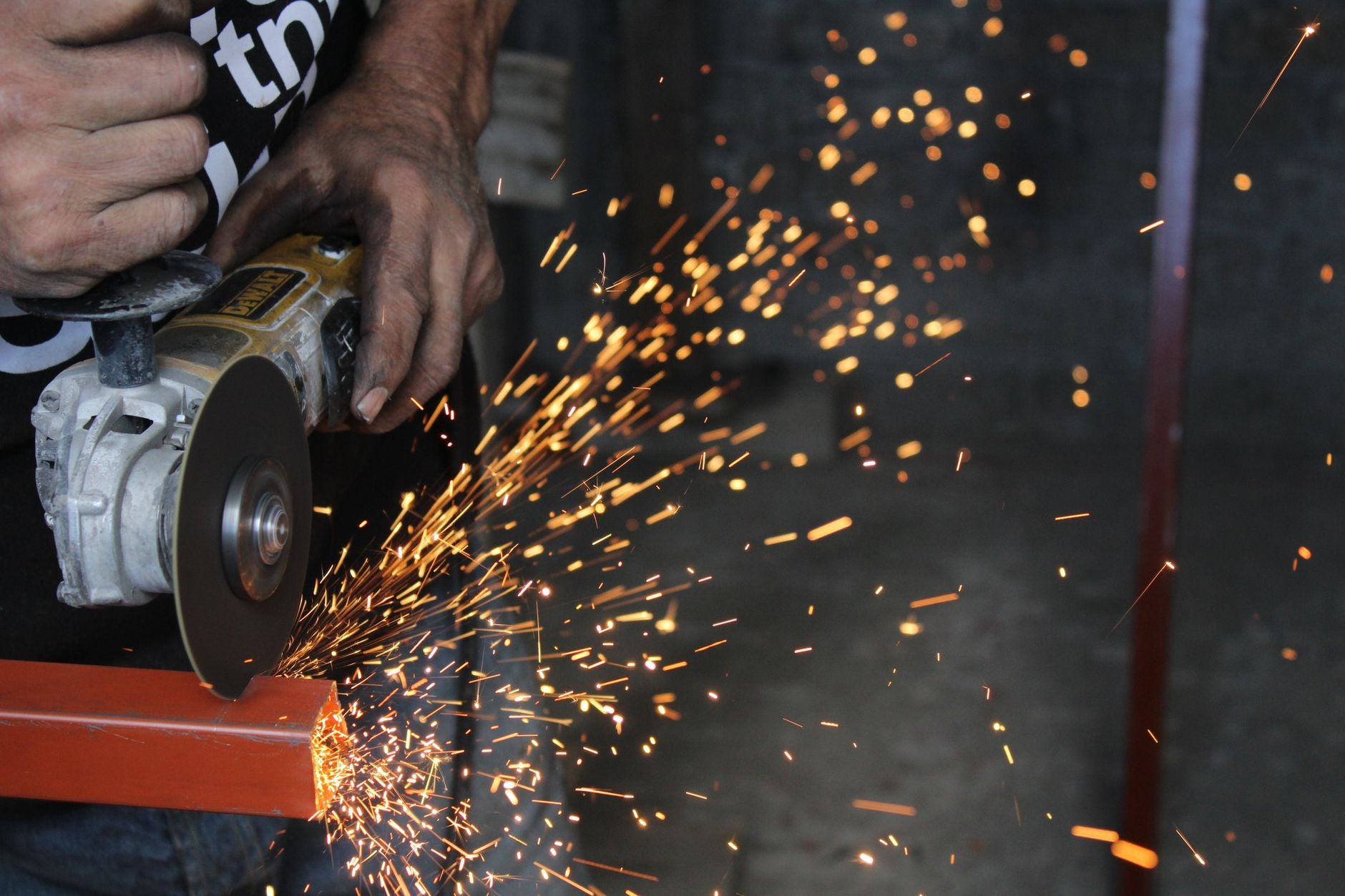
No, you should not grind with a cutting disc. A cutting disc (Type 1/41 flat, or the thin Type 27/42 depressed-centre form) is built to remove metal on its outer edge only, held at 90 degrees to the work. ANSI B7.1, the North American abrasive-wheel safety standard, treats the periphery as the only acceptable grinding surface on a cutting wheel, and UAMA guidance says it plainly: cutting only, straight lines only, no side pressure (ANSI B7.1; UAMA; KB: Working Angle and Pressure). If the job is grinding, use a Type 27 grinding wheel (about 1/4 in thick) or a flap disc. Both are actually built for face work.
The hard rule: edge only, no side load
Every serious source lands on the same rule. Cutting wheels are not designed for use on their sides; they work on the outer periphery only, and pressure on the flat of the wheel weakens it and can make it burst (UAMA; KB: Cutting-Off Technique). The UAMA safety guide for grinding wheels puts it as a straight prohibition: do not side-grind or apply side pressure to a Type 1/41 or Type 27/42 cutting wheel, cut in straight lines only, and never use a cutting wheel for anything except cutting (UAMA; KB: Troubleshooting Cut-Off Wheel Pinching and Kickback).
This is not lawyer caution. Side loading is the main real-world failure mode of portable cut-off wheels (ANSI B7.1 guidance; KB: Cut-Off Wheel), and breakage analyses list side pressure and twisting alongside pinching as the dominant causes of mid-cut shattering (KB: Cutting-Off Technique). Grinding with a cutting disc is the deliberate version of the same mistake: applying, on purpose and continuously, the one load the wheel is least able to carry. Every disc in our cutting wheel range is a cutting wheel, for edge use only, the same rule every reputable brand states.
Read the thickness, not the shape
The Type number on a disc describes its shape, not its duty. A depressed-centre disc can be a 1/4 in grinding wheel or a 0.045 in cutting wheel; both carry the same offset-hub profile, and OSHA even gives the thin cutting version its own designation, Type 27A (OSHA definitions; KB: Depressed-Center Wheel Geometry). What tells you the duty is the thickness and the marked use. Memorise the decode below; our cut-off wheel buying guide covers the rest of the selection logic.
| Thickness | Metric | What it is | Side grinding? |
|---|---|---|---|
| 0.040 in | ~1.0 mm | Ultra-thin cutting disc: sheet, tube, stainless | Never |
| 0.045 in | ~1.1 mm | General-fabrication cutting disc, the volume seller | Never |
| 1/16 in | ~1.6 mm | Heavier hand cutting, more durability | Never |
| 3/32 in | ~2.5 mm | Chop-saw and stationary cutting wheels | Never |
| 1/8 in | ~3.2 mm | Heavy stock and stationary-saw cutting wheels | Never |
| 1/4 in | ~6.4 mm | Type 27 depressed-centre grinding wheel | Yes: the face is the working surface |
The threshold is easy to hold on to. Hand-held cutting discs run from about 1 mm up to 1/8 in, and everything in that band is edge-only, including the Type 27/42 cut-off at 1/8 in or less (KB: Cut-Off Wheel). The everyday grinding wheel is about 1/4 in (6.4 mm) thick, more than five times the section of the 0.045 in cutting disc sold for the same 4-1/2 in grinder (KB: Depressed-Center Wheel). That gap in cross-section is why one tolerates face work and the other does not.
Why a thin wheel shatters under side load
A cutting disc is a brittle laminate: abrasive grain in a phenolic resin matrix, with woven fibreglass mesh cured in as reinforcement. The resin-and-grain body has almost no tensile strength of its own. The glass mesh carries the hoop stress that stops the disc tearing itself apart at speed, and the highest-tensile layers sit at or near the two faces, exactly where bending and side-load stress concentrate (KB: Fibreglass Mesh Reinforcement). In a 1 mm wheel that structure is compressed into the thickness of a coin, leaving little material to resist lateral load (KB: Thin Cut-Off Wheel).
In its own plane the disc is remarkably strong. Off-hand cutting discs run at rim speeds up to 80 m/s, around 13,300 RPM on a 4-1/2 in disc (KB: Cut-Off Wheel), and under EN 12413, the European counterpart standard, a bonded wheel must survive a burst test at 1.73 times its marked maximum speed (EN 12413; KB: Fibreglass Mesh Reinforcement). But that whole margin is centrifugal. It says nothing about side load, which is why EN 12413 and the oSa certification scheme test lateral strength separately with a single-point side-load test plus impact and bending/shear tests. As oSa puts it, "a slight tilt or a curved cut is enough to cause enormous lateral loads" (oSa; KB: Fibreglass Mesh Reinforcement).
Tip the disc over to grind and the grinder becomes a lever working against a wafer of brittle composite. Bending stress starts cracks the reinforcement was never laid up to stop, the cracks grow with every pass, and at full rim speed a crack becomes fragments. Double-layer mesh, standard on hand-held cutting wheels, raises the side-load threshold but does not make side grinding safe (KB: Fibreglass Mesh Reinforcement). Most "the disc exploded" stories trace back to exactly this: side load, twisting or pinching rather than a defective wheel (KB: Troubleshooting Cut-Off Wheel Pinching and Kickback). Our overview of EN 12413, oSa and ANSI explains how the test regimes fit together.
What ANSI B7.1 actually allows
ANSI B7.1 (current edition ANSI/UAMA B7.1-2017) is the North American standard for the use, care and protection of abrasive wheels, administered by UAMA, referenced by OSHA 29 CFR 1910.215 (which makes it effectively mandatory in US workplaces) and treated as the de facto benchmark in Canada (OSHA 1910.215; KB: ANSI B7.1 Standard). Three of its positions settle this question.
- Periphery only. The standard treats the periphery as the only acceptable grinding surface on a cutting wheel. Side pressure creates bending stress the wheel is not designed to handle, so a cutting wheel is never side-ground unless it is specifically marked for that use (ANSI B7.1; UAMA; KB: Working Angle and Pressure).
- The crossover runs one way. In OSHA's companion definitions, a Type 27 grinding wheel carries a flat grinding rim that permits notching and cutting, while Type 27A is the dedicated thin cutting-off version (OSHA; KB: Depressed-Center Wheel Geometry). The standards recognise a thick grinding wheel doing occasional edge work; there is no sanctioned form of a thin cutting wheel doing face work.
- The guards are different. A Type 1 cutting guard must cover a full 180 degrees on the sides of the wheel, while a Type 27 grinding guard is open at the bottom so the face can reach the work (KB: Cutting-Off Technique). A grinder set up for cutting is not guarded for grinding, and vice versa.
European-marked discs make the rule visible: EN 12413 and oSa marking rules put EN ISO 7010 restriction pictograms on the disc, and "not for side grinding" is a standard mark on cutting discs (oSa; KB: Cut-Off Wheel). Speed marking is the other half of the rulebook; see our guide to max RPM and ANSI B7.1.
What to grind with instead
The right tool costs no more than the wrong one and lasts longer.
- Type 27 grinding wheel. About 1/4 in thick, worked on its face at 0 to 45 degrees, sweet spot 25 to 30 (KB: Working Angle and Pressure). The tool for heavy weld removal and bevelling; our grinding wheels cover the standard 4-1/2 in, 5 in and 7 in sizes.
- Flap disc. A flat Type 27 flap disc grinds and blends at 0 to 15 degrees; a conical Type 29 hogs metal at 15 to 35 degrees (KB: Working Angle and Pressure). Flap discs grind and finish in one step; our flap disc range covers both geometries, and our grinding wheel vs flap disc comparison walks through the choice.
The rule runs both ways
One disc, one duty. A 1/4 in Type 27 grinding wheel must never be used edge-on as a cutting wheel: it is built for face grinding, and the geometry number alone does not tell you cut versus grind, so read the thickness and the marked use every time (KB: Cut-Off Wheel). Likewise, Type 28 and Type 29 face wheels may only be used on the face and never on the periphery for cutting-off, a safety constraint in the shape definitions, not a preference (KB: Depressed-Center Wheel Geometry). Swapping duties in either direction puts the load where the reinforcement is not.
FAQ
Can I use a cutting disc for grinding if I am careful?
No. Care does not change the mechanics: a cutting disc is a thin brittle laminate with its reinforcement laid up for edge loads, and ANSI B7.1 treats the periphery as its only acceptable working surface (ANSI B7.1; UAMA; KB: Working Angle and Pressure). Even light chamfering on the flat starts the crack-then-shatter sequence.
How do I tell a cutting disc from a grinding disc?
Read the thickness and the marked use, not the shape. Hand-held cutting discs run about 1 mm to 1/8 in; grinding wheels run about 1/4 in (KB: Cut-Off Wheel; KB: Depressed-Center Wheel). EN-marked cutting discs also carry a "not for side grinding" pictogram (oSa marking requirements; KB: Cut-Off Wheel).
Is a depressed-centre cutting disc safe for side grinding?
No. The depressed centre on a thin Type 27/42 cutting disc exists to recess the mounting nut for flush cuts and better sight lines, not to add lateral strength (KB: Depressed-Center Wheel Geometry). UAMA's prohibition on side pressure names Type 27/42 cutting wheels explicitly, right alongside flat Type 1/41 (UAMA; KB: Troubleshooting Cut-Off Wheel Pinching and Kickback).
What actually happens when you side-grind a thin cutting disc?
Bending stress cracks the resin body in a direction the fibreglass mesh was not placed to resist, and at rim speeds up to 80 m/s a crack becomes flying fragments (KB: Fibreglass Mesh Reinforcement; KB: Cut-Off Wheel). Side load, twisting and pinching are the dominant causes of cut-off wheel shatter (KB: Cutting-Off Technique).
Can I use a grinding wheel for cutting instead?
No. A 1/4 in Type 27 grinding wheel is built for face work and must never be used edge-on for cutting (KB: Cut-Off Wheel). The only crossover the standards recognise runs the other way: OSHA's Type 27 grinding wheel definition permits notching and cutting on its rim (OSHA; KB: Depressed-Center Wheel Geometry).
What should I use instead of a cutting disc for grinding?
A Type 27 grinding wheel at 25 to 30 degrees for heavy stock removal, or a flap disc (flat Type 27 at 0 to 15 degrees, conical Type 29 at 15 to 35 degrees) when you want grinding and finishing in one step (KB: Working Angle and Pressure). Both are engineered and guarded for face contact.